

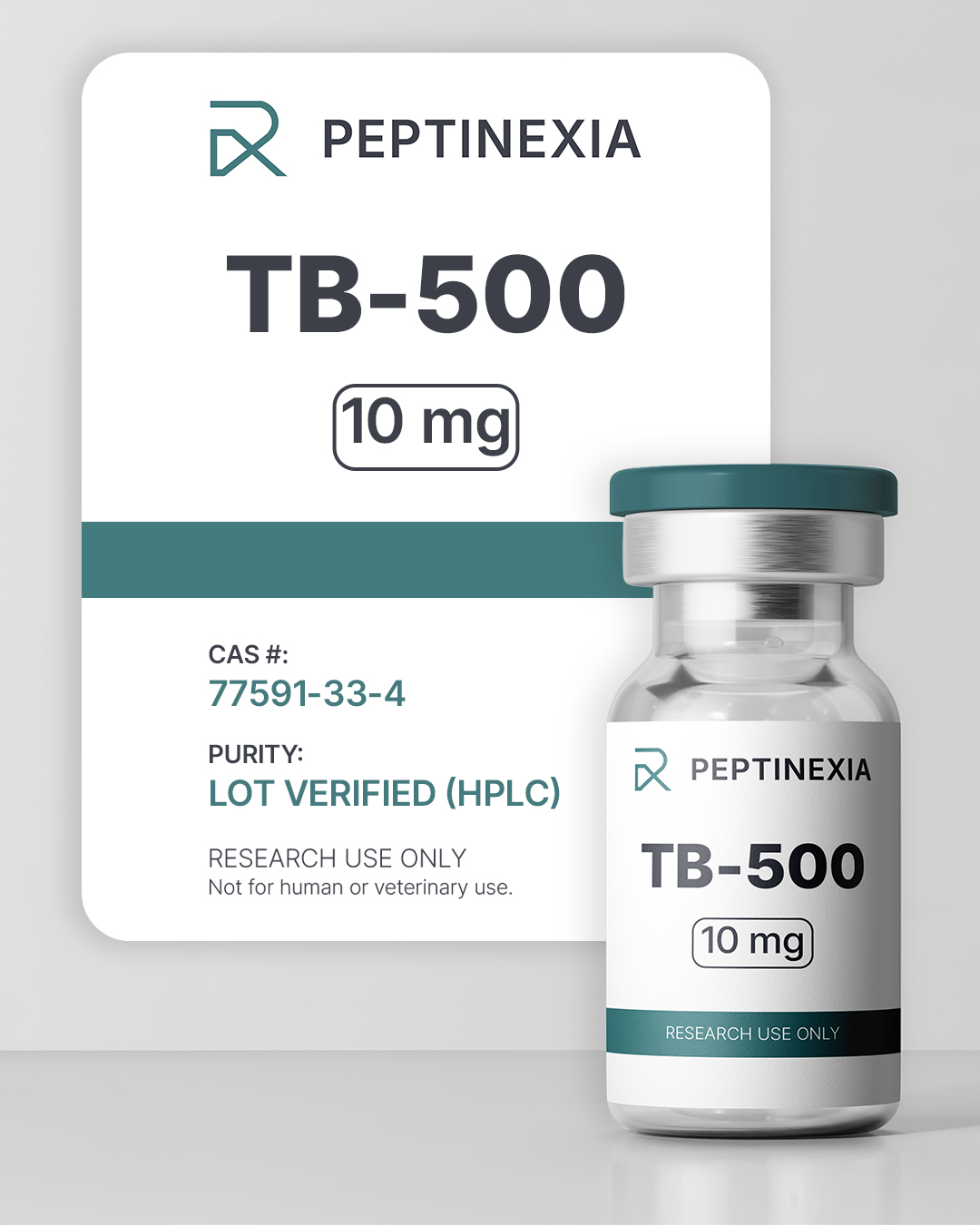
TB-500

TB-500 is a synthetic form of thymosin beta-4 investigated for its role in actin regulation, cellular migration, and tissue remodeling processes in preclinical research models.

$50.00

98 in stock

$50.00
1 - 2 vials
$47.50 (5% off)
3 - 5 vials
$45.00 (10% off)
6+ vials

What is TB-500?
TB-500 is a synthetic form of thymosin beta-4 (TB4), a naturally occurring peptide widely distributed throughout mammalian tissues. Thymosin beta-4 participates in cellular processes involving actin regulation, cell migration, and tissue remodeling, and has been extensively studied in preclinical research investigating biological repair and regenerative signaling mechanisms.

Research Interest
TB-500 is investigated in research settings for mechanisms associated with tissue repair and cellular responses to injury. Areas of study include cell migration, angiogenesis, inflammatory signaling, and connective tissue remodeling. Researchers examine how thymosin beta-4 influences coordinated cellular movement and structural organization during biological recovery processes.

Mechanisms Under Investigation
Thymosin beta-4 binds actin, a structural protein essential for maintaining cell shape and enabling cellular movement. Research explores how modulation of actin dynamics affects cellular migration, blood vessel formation, and tissue remodeling pathways. These mechanisms are primarily studied in laboratory and animal models examining coordinated repair and regenerative signaling systems.

Current State of Research
Scientific literature on thymosin beta-4 includes extensive preclinical investigation across multiple tissue systems, with ongoing research focused on clarifying its signaling roles, biological distribution, and regulatory effects within cellular repair pathways. Human clinical research remains limited, and investigation into its broader biological activity is ongoing.
Lot IDPurityNet ContentEndotoxinSterility
TB5010031626199.7 %11.1 mg (111.3 %)19.7 EU/vial
Content
10 mg
Lot Size
100 vials
Purity
99.7 %
Net Content
11.1 mg (111.3 %)
Endotoxin
19.7 EU/vial
Sterility

Lyophilized (Dry Powder) — Unopened Vials
Unopened lyophilized vials should be stored away from direct light and heat. For use within a few weeks, room temperature storage is acceptable. For storage over several months, refrigeration at 2–8°C (36–46°F) is recommended. For long-term storage, freezing best preserves peptide integrity.

When removing a vial from frozen storage, allow it to reach room temperature before opening to prevent condensation from introducing moisture into the vial.

Reconstitution
Reconstitute using bacteriostatic water (BAC). Inject the solution slowly down the inside wall of the vial rather than directly onto the peptide cake. Gently swirl until fully dissolved; do not shake. Vigorous shaking may cause foaming and mechanical stress to the peptide structure.

Reconstituted Vials
After reconstitution, store vials refrigerated at 2–8°C (36–46°F) and protected from light. Always use clean, sterile technique when accessing the vial to minimize contamination.

With proper refrigerated storage and aseptic handling, reconstituted peptide solutions commonly remain stable well beyond the frequently cited 28-day guideline, which pertains to the antimicrobial effectiveness of bacteriostatic water rather than the intrinsic peptide stability. Many researchers maintaining consistent sterile technique report usable stability in the 60–90 day range under controlled conditions.

General Guidelines

  • Keep vials away from excessive heat and prolonged light exposure.
  • Do not freeze after reconstitution.
  • Discard any solution showing cloudiness, discoloration, or visible particulate matter.
  • Label vials with the reconstitution date for tracking purposes.

Study 1: Thymosin Beta-4 Promotes Cell Migration and Accelerates Wound Healing

Authors: Malinda KM et al.
Source: Nature Medicine

Scientific Findings
This study investigated the effects of thymosin beta-4 on cellular migration and wound repair processes. Researchers observed that thymosin beta-4 stimulated endothelial and epithelial cell migration and accelerated wound closure in animal models. Increased cellular movement was associated with actin reorganization, a key component of tissue repair responses.

The findings identified thymosin beta-4 as an actin-regulating peptide capable of influencing coordinated cellular migration during early phases of tissue repair in preclinical models.

Plain English Interpretation
Scientists studied how thymosin beta-4 affects injured tissue and found that it helped cells move more efficiently into damaged areas. Because cell movement is essential for healing, researchers concluded that the peptide may play an important role in organizing early repair responses.


Study 2: Thymosin Beta-4 Induces Angiogenesis Through Endothelial Cell Activation

Authors: Smart N et al.
Source: Circulation Research

Scientific Findings
This research examined the role of thymosin beta-4 in vascular development and angiogenesis. Investigators demonstrated increased endothelial cell migration and new blood vessel formation following thymosin beta-4 exposure in experimental models. The peptide influenced signaling pathways involved in vascular growth and tissue remodeling.

Results suggested thymosin beta-4 contributes to coordinated vascular responses that support tissue remodeling and recovery processes in preclinical systems.

Plain English Interpretation
Researchers explored how thymosin beta-4 affects blood vessel formation and observed increased development of new vessels in laboratory models. Improved blood vessel growth can help deliver oxygen and nutrients to tissues undergoing repair.


Study 3: Actin Sequestration by Thymosin Beta-4 Regulates Cellular Structure and Movement

Authors: Huff T et al.
Source: FEBS Letters

Scientific Findings
This mechanistic study examined thymosin beta-4 as a major actin-binding protein regulating cytoskeletal dynamics. Researchers demonstrated that thymosin beta-4 binds monomeric actin, influencing polymerization processes responsible for cell shape and motility.

These findings established thymosin beta-4 as an important regulator of cytoskeletal organization, providing a molecular explanation for its observed effects on cellular migration and tissue remodeling in experimental models.

Plain English Interpretation
Scientists investigated how thymosin beta-4 works at the cellular level and found it interacts directly with actin, a protein that controls how cells move and maintain their shape. This helps explain why the peptide is studied in processes involving tissue repair and cellular movement.


Study 4: Thymosin Beta-4 and Tissue Protection in Cardiac Injury Models

Authors: Bock-Marquette I et al.
Source: Nature

Scientific Findings
This study evaluated thymosin beta-4 activity in experimental cardiac injury models. Administration of thymosin beta-4 was associated with increased cell survival signaling, enhanced vascularization, and improved tissue organization following injury. Researchers observed activation of pathways involved in cellular migration and survival responses.

The work expanded understanding of thymosin beta-4 as a multifunctional signaling peptide influencing tissue remodeling and recovery mechanisms across multiple tissue systems in preclinical research.

Plain English Interpretation
In heart injury models, researchers found that thymosin beta-4 supported cell survival and encouraged new blood vessel growth. These findings helped scientists understand how the peptide may coordinate multiple biological processes involved in tissue recovery.

Batch Details
ID
Content
Received Date
Lot Size
vials
Crimp Color
Cap Color
Testing Lab
Lab ID
Test Date
Peptide Purity
Net Peptide Content
Peptide-to-Excipients Ratio
Endotoxin
Sterility