

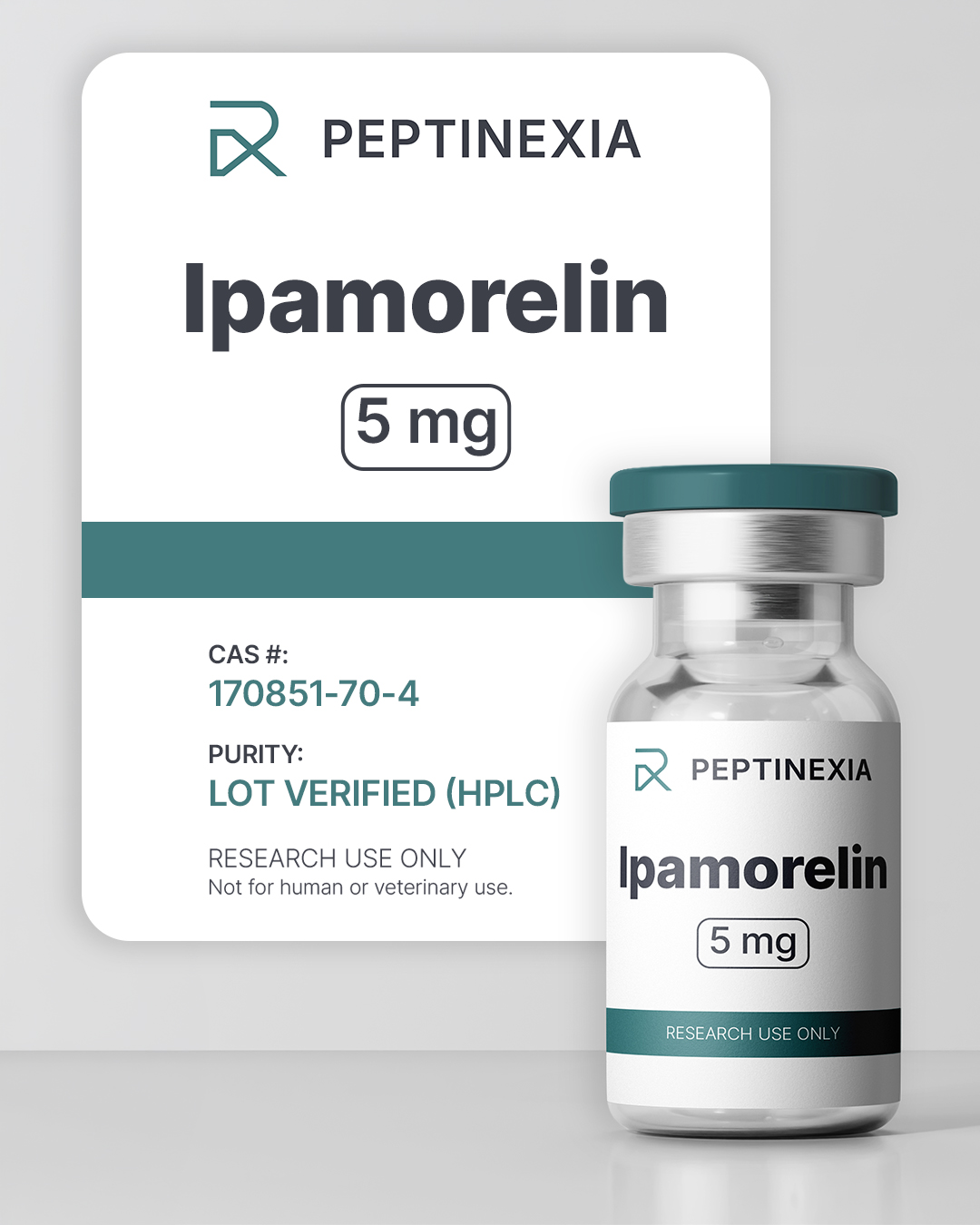
Ipamorelin

Ipamorelin is a selective growth hormone secretagogue peptide investigated for ghrelin receptor–mediated signaling involved in endogenous growth hormone regulation.

$30.00

What is Ipamorelin?
Ipamorelin is a synthetic pentapeptide classified as a selective growth hormone secretagogue. It is studied for its activity at the growth hormone secretagogue receptor (GHSR-1a), also known as the ghrelin receptor, where it influences endogenous growth hormone signaling pathways.

Research Interest
Ipamorelin is being investigated in research on the neuroendocrine regulation of growth hormone release and downstream metabolic signaling. Areas of study include growth hormone pulsatility, insulin-like growth factor-1 (IGF-1) signaling, appetite-related pathways, and broader endocrine mechanisms associated with ghrelin receptor activity.

Mechanisms Under Investigation
Research suggests Ipamorelin stimulates growth hormone release through selective activation of ghrelin receptor signaling pathways. Unlike earlier secretagogues with broader endocrine activity, Ipamorelin has been studied for its relative receptor selectivity and its ability to influence physiologic growth hormone signaling with limited activity on other pituitary hormone pathways.

Current State of Research
Scientific literature on Ipamorelin includes preclinical investigation and human pharmacokinetic and pharmacodynamic research examining its receptor activity and endocrine signaling effects. Ongoing research explores ghrelin receptor biology and the broader physiological roles of selective growth hormone secretagogues.
Lot IDPurityNet ContentEndotoxinSterility
IPA005032326199.9%4.7 mg (94.6%)11.6 EU/vial
Content
5 mg
Lot Size
100 vials
Purity
99.9%
Net Content
4.7 mg (94.6%)
Endotoxin
11.6 EU/vial
Sterility

Lyophilized (Dry Powder) — Unopened Vials
Store unopened lyophilized vials protected from heat, moisture, and direct light exposure. For short-term storage, room temperature conditions are acceptable. For storage over several months, refrigeration at 2–8°C (36–46°F) is recommended. Freezing may be used for long-term preservation of the dry peptide.

When removing a vial from frozen storage, allow it to reach room temperature before opening to prevent condensation from introducing moisture into the vial.

Reconstitution
Reconstitute using bacteriostatic water (BAC). Inject the solution slowly down the inside wall of the vial rather than directly onto the peptide cake. Allow the powder to dissolve naturally and gently swirl if necessary. Do not shake, as vigorous agitation may introduce foaming and mechanical stress to the peptide structure.

After Reconstitution
Store reconstituted solutions refrigerated at 2–8°C (36–46°F) and protected from light. Use clean sterile technique when accessing the vial to minimize contamination.

General Guidelines

  • Do not freeze after reconstitution.
  • Avoid repeated temperature cycling.
  • Protect reconstituted solutions from prolonged light exposure.
  • Discard any solution showing cloudiness, discoloration, or visible particulate matter.
  • Label vials with the reconstitution date.

Study 1: Ipamorelin, the First Selective Growth Hormone Secretagogue

Authors: K. Raun et al.
Source: European Journal of Endocrinology

Scientific Findings
This foundational study characterized Ipamorelin as a selective growth hormone secretagogue. Researchers found that Ipamorelin stimulated growth hormone release with high potency while showing minimal effects on other endocrine pathways, including ACTH and cortisol, compared with less selective secretagogues.

Plain English Interpretation
Scientists found that Ipamorelin was able to stimulate growth hormone signaling while remaining more selective than earlier compounds in the same class. That selectivity is one of the main reasons it continues to be studied in endocrine signaling research.


Study 2: Pharmacokinetic-Pharmacodynamic Modeling of Ipamorelin in Healthy Volunteers

Authors: J.V.S. Gobburu et al.
Source: Pharmaceutical Research

Scientific Findings
This human study examined the pharmacokinetics and pharmacodynamics of Ipamorelin in healthy volunteers. Investigators measured circulating peptide concentrations and growth hormone responses across escalating dose levels, providing clinical data on its endocrine signaling behavior in humans.

Plain English Interpretation
Researchers studied how Ipamorelin behaves in the body and how strongly it affects growth hormone signaling in people. The study helped establish a clearer picture of its timing and endocrine response profile.


Study 3: Ipamorelin and Ghrelin Receptor–Mediated Gastrointestinal Signaling

Authors: K. Venkova et al.
Source: Neurogastroenterology & Motility

Scientific Findings
This experimental study investigated Ipamorelin as a ghrelin receptor agonist in a rodent model of postoperative ileus. Researchers observed accelerated gastrointestinal transit and improved gastric motility–related measures, supporting broader ghrelin receptor signaling activity beyond pituitary hormone release.

Plain English Interpretation
Scientists found that Ipamorelin influenced gut motility in laboratory models, showing that ghrelin receptor signaling has biological effects extending beyond growth hormone pathways alone.


Study 4: Dual Regulation of Growth Hormone Secretion Through Ghrelin-System Signaling

Authors: J.D. Veldhuis, M.L. Bowers, and related review literature
Source: Integrating GHS into the Ghrelin System

Scientific Findings
This review examined the role of growth hormone secretagogues within the broader ghrelin signaling system. The authors described how compounds such as Ipamorelin engage receptor pathways that interact with physiologic growth hormone regulation, appetite-related signaling, and neuroendocrine feedback mechanisms.

Plain English Interpretation
Researchers reviewed how growth hormone secretagogues fit into the body’s larger ghrelin signaling network. This helps explain why Ipamorelin is studied not only for growth hormone release, but also for broader neuroendocrine signaling biology.

Batch Details
ID
Content
Received Date
Lot Size
vials
Crimp Color
Cap Color
Testing Lab
Lab ID
Test Date
Peptide Purity
Net Peptide Content
Peptide-to-Excipients Ratio
Endotoxin
Sterility