

| Lot ID | Purity | Net Content | Endotoxin | Sterility |
|---|---|---|---|---|
| MOT0400616261 | 99.456% | 41.14 mg (102.85%) | < 0.20 EU/mL | Pass |
| MOT0100612261 | 99.727% | 8.70 mg (87%) | < 0.20 EU/mL | Pass |
MOTS-c
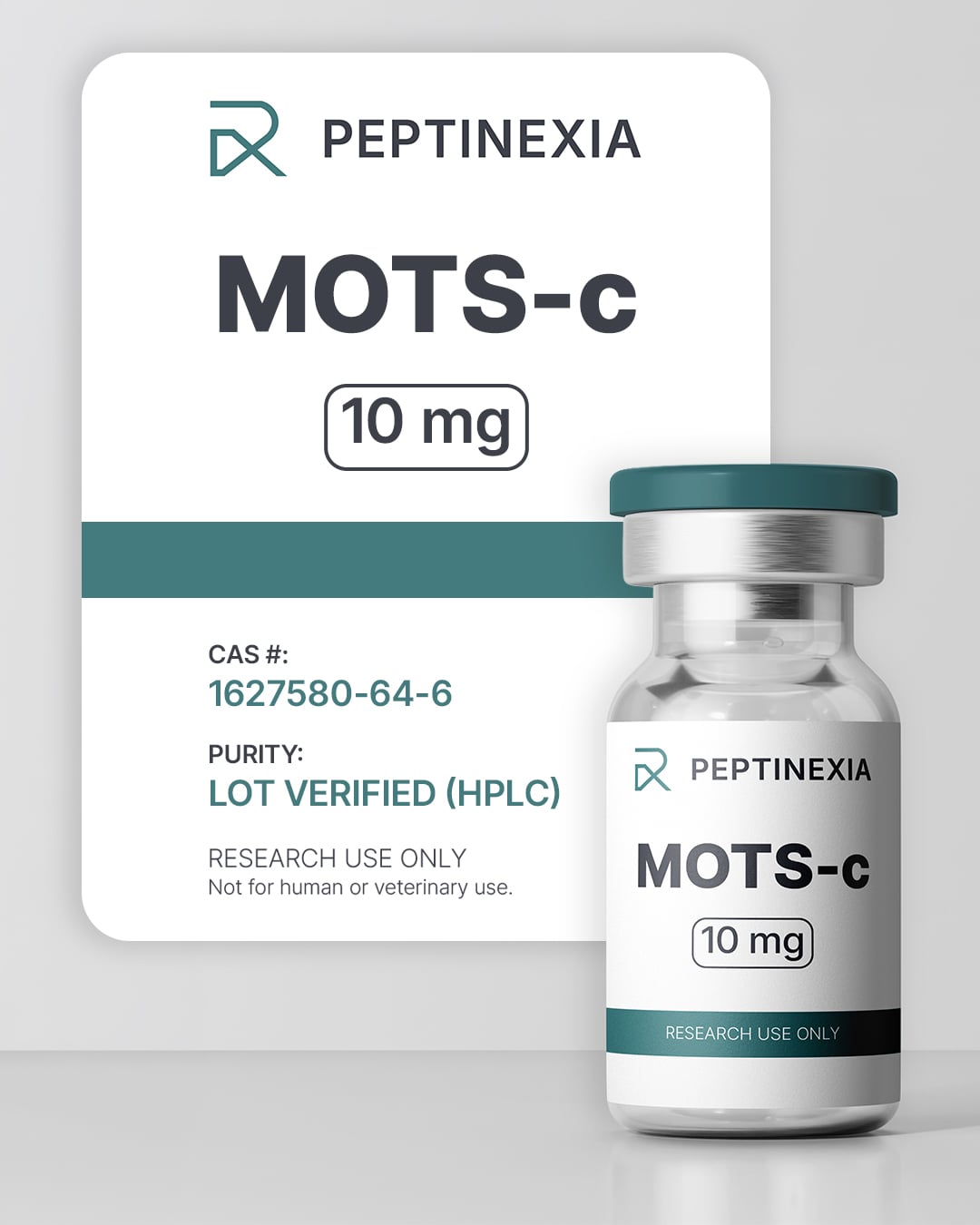
MOTS-c is a mitochondrial-derived peptide investigated for its role in metabolic regulation, cellular energy signaling, and stress-response pathways in preclinical and human research models.
Price range: $25.00 through $70.00
What is MOTS-c?
MOTS-c is a mitochondrial-derived peptide encoded within mitochondrial DNA and naturally produced in cells as part of metabolic signaling processes. Unlike most peptides encoded by nuclear genes, MOTS-c originates from the mitochondrial genome and has been studied for its role in regulating cellular energy balance and adaptive stress responses in both preclinical and human research models.
Research Interest
MOTS-c is investigated for mechanisms related to metabolic regulation and cellular adaptation to energetic stress. Research areas include glucose metabolism, insulin signaling pathways, mitochondrial function, exercise-related metabolic responses, and age-associated changes in metabolic homeostasis. Scientists examine how mitochondrial signaling peptides coordinate communication between cellular energy status and nuclear gene expression.
Mechanisms Under Investigation
Studies suggest MOTS-c may influence metabolic pathways through activation of AMP-activated protein kinase (AMPK) and regulation of genes involved in energy utilization and stress resistance. Research has shown that MOTS-c can translocate to the nucleus under metabolic stress conditions, where it may help regulate adaptive cellular responses linking mitochondrial activity with genomic signaling pathways.
Current State of Research
Scientific investigation of MOTS-c includes both preclinical studies and early human research examining metabolic and physiological signaling effects. Ongoing research continues to explore its role as a mitochondrial signaling peptide and its broader implications for metabolic regulation and cellular adaptation mechanisms.
Lyophilized (Dry Powder) — Unopened Vials
Unopened lyophilized vials should be stored away from direct light and heat. For use within a few weeks, room temperature storage is acceptable. For storage over several months, refrigeration at 2–8°C (36–46°F) is recommended. For long-term storage, freezing best preserves peptide integrity.
When removing a vial from frozen storage, allow it to reach room temperature before opening to prevent condensation from introducing moisture into the vial.
Reconstitution
Reconstitute using bacteriostatic water (BAC). Inject the solution slowly down the inside wall of the vial rather than directly onto the peptide cake. Gently swirl until fully dissolved; do not shake. Vigorous shaking may cause foaming and mechanical stress to the peptide structure.
Reconstituted Vials
After reconstitution, store vials refrigerated at 2–8°C (36–46°F) and protected from light. Always use clean, sterile technique when accessing the vial to minimize contamination.
With proper refrigerated storage and aseptic handling, reconstituted peptide solutions commonly remain stable well beyond the frequently cited 28-day guideline, which pertains to the antimicrobial effectiveness of bacteriostatic water rather than the intrinsic peptide stability. Many researchers maintaining consistent sterile technique report usable stability in the 60–90 day range under controlled conditions.
General Guidelines
- Keep vials away from excessive heat and prolonged light exposure.
- Do not freeze after reconstitution.
- Discard any solution showing cloudiness, discoloration, or visible particulate matter.
- Label vials with the reconstitution date for tracking purposes.
Study 1: A Mitochondrial-Derived Peptide Regulates Metabolic Homeostasis
Authors: Lee C. et al.
Source: Cell Metabolism
Scientific Findings
This foundational study identified MOTS-c as a peptide encoded within mitochondrial DNA and demonstrated its role in regulating metabolic homeostasis. Researchers observed improvements in glucose metabolism and insulin sensitivity in experimental models, linked to activation of cellular energy-regulation pathways.
The findings established MOTS-c as a mitochondrial signaling molecule capable of influencing systemic metabolic regulation through intracellular communication pathways.
Plain English Interpretation
Scientists discovered that mitochondria produce signaling peptides that help regulate metabolism. MOTS-c appeared to influence how cells manage energy and glucose use, revealing a new way mitochondria communicate with the rest of the cell.
Study 2: MOTS-c Translocation to the Nucleus Under Metabolic Stress
Authors: Kim KH et al.
Source: Nature
Scientific Findings
This study demonstrated that MOTS-c moves from mitochondria to the nucleus during metabolic stress conditions. Once in the nucleus, the peptide influenced gene expression programs involved in stress adaptation and metabolic regulation. Activation of AMPK signaling pathways was associated with these adaptive responses.
The work revealed a novel mechanism linking mitochondrial signaling directly to nuclear gene regulation.
Plain English Interpretation
Researchers found that during metabolic stress, MOTS-c travels into the cell’s nucleus and helps regulate genes involved in energy balance. This showed that mitochondria can directly influence how cells adapt to changing energy demands.
Study 3: MOTS-c Enhances Physical Capacity and Metabolic Adaptation in Experimental Models
Authors: Reynolds JC et al.
Source: Cell Metabolism
Scientific Findings
Researchers evaluated MOTS-c in models examining metabolic adaptation and physical performance. Treatment was associated with improved metabolic flexibility and enhanced adaptive responses to physiological stress. Observed effects were linked to regulation of energy utilization pathways and mitochondrial signaling mechanisms.
The findings supported the role of MOTS-c as a regulator of adaptive metabolic responses under stress conditions.
Plain English Interpretation
Scientists studying metabolic adaptation found that MOTS-c influenced how organisms adjusted to physical and metabolic stress. The peptide appeared to help cells use energy more efficiently during demanding conditions.
Study 4: Circulating MOTS-c Levels and Metabolic Regulation in Humans
Authors: Ramanjaneya M. et al.
Source: Scientific Reports
Scientific Findings
This human study measured circulating MOTS-c levels and examined associations with metabolic parameters. Researchers observed relationships between MOTS-c concentrations and markers of metabolic regulation, supporting its role as a mitochondrial-derived signaling peptide in human physiology.
The study provided early human evidence linking mitochondrial peptides to systemic metabolic signaling processes.
Plain English Interpretation
Researchers measured MOTS-c levels in people and found connections between the peptide and metabolic markers. This suggests mitochondrial signaling peptides may play a role in how the human body regulates energy balance.

