

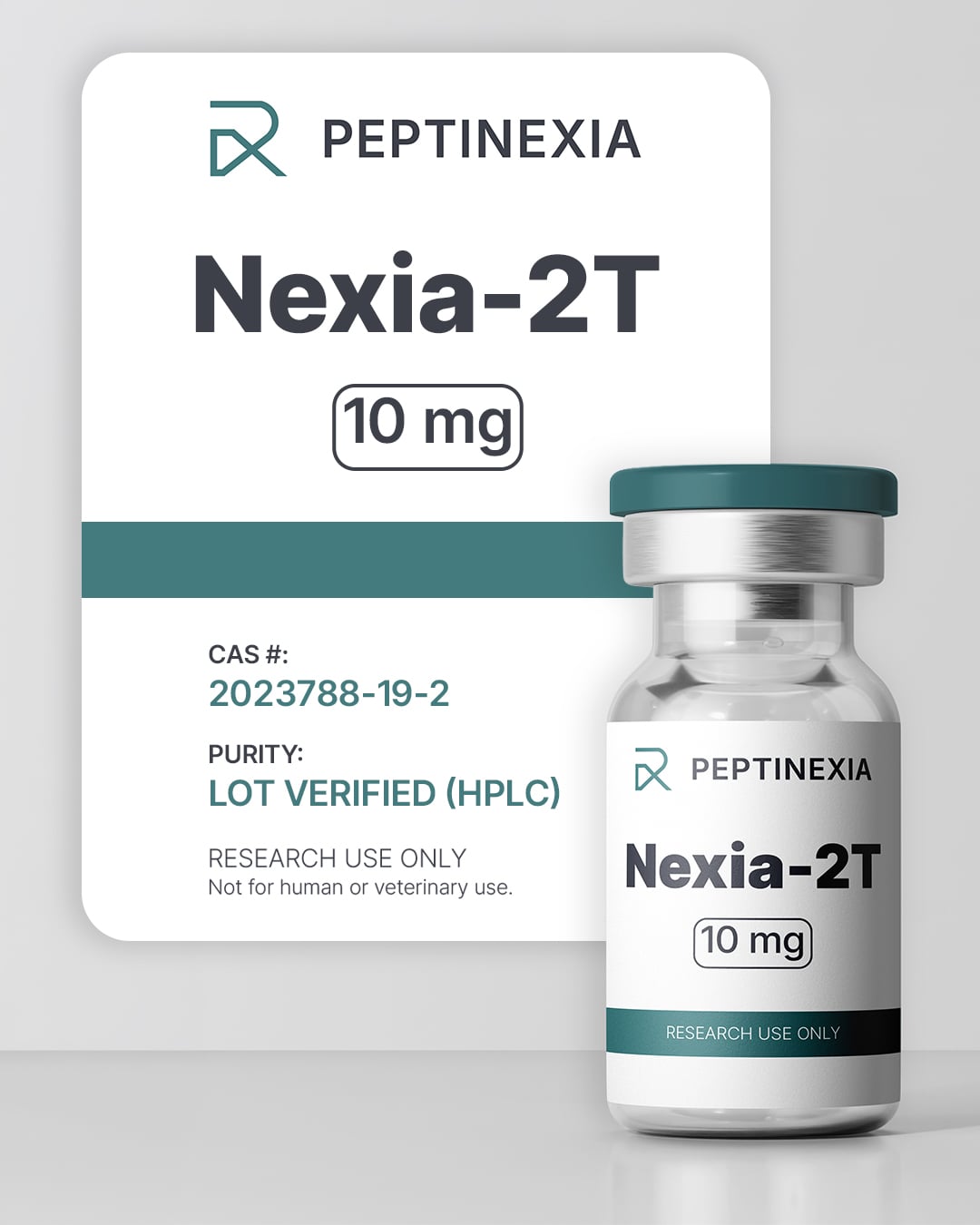
Nexia-2T

Nexia-2T is a dual GIP/GLP-1 receptor agonist investigated for metabolic signaling, glucose regulation, and energy-balance mechanisms in clinical and preclinical research models.

$35.00

In stock

$35.00
1 - 2 vials
$33.25 (5% off)
3 - 5 vials
$31.50 (10% off)
6+ vials
Lot IDPurityNet ContentEndotoxinSterility
NX2010052826199.746%12.63 mg (126.3%)< 0.20 EU/mLPass
Purity
99.746%
Net Content
12.63 mg (126.3%)
Endotoxin
< 0.20 EU/mL
Sterility
Pass

What is Nexia-2T?
Nexia-2T is a synthetic peptide designed as a dual agonist of the glucose-dependent insulinotropic polypeptide (GIP) and glucagon-like peptide-1 (GLP-1) receptors. It has been studied extensively for its effects on metabolic signaling, glucose regulation, appetite-related pathways, and energy balance in both clinical and preclinical research settings.

Research Interest
Nexia-2T is being investigated for mechanisms underlying metabolic homeostasis and whole-body energy regulation. Research areas include glucose metabolism, insulin signaling, body-weight regulation, gastric emptying, lipid metabolism, and broader endocrine pathways involved in nutrient handling and satiety signaling.

Mechanisms Under Investigation
Studies suggest Nexia-2T works through coordinated activation of both GIP and GLP-1 receptor pathways. Researchers examine how this dual-receptor activity influences insulin secretion, glucagon regulation, appetite signaling, gastric emptying, and downstream metabolic responses compared with single-pathway incretin agonists.

Current State of Research
Scientific literature on dual GIP/GLP-1 receptor agonists includes multiple large human clinical trials and ongoing mechanistic investigation. Published research continues to evaluate receptor-signaling profiles and broader roles in metabolic regulation and endocrine physiology.
Lyophilized (Dry Powder) — Unopened Vials
Unopened lyophilized vials should be stored away from direct light and heat. For use within a few weeks, room temperature storage is acceptable. For storage over several months, refrigeration at 2–8°C (36–46°F) is recommended. For long-term storage, freezing best preserves peptide integrity.

When removing a vial from frozen storage, allow it to reach room temperature before opening to prevent condensation from introducing moisture into the vial.

Reconstitution
Reconstitute using bacteriostatic water (BAC). Inject the solution slowly down the inside wall of the vial rather than directly onto the peptide cake. Gently swirl until fully dissolved; do not shake. Vigorous shaking may cause foaming and mechanical stress to the peptide structure.

Reconstituted Vials
After reconstitution, store vials refrigerated at 2–8°C (36–46°F) and protected from light. Always use clean, sterile technique when accessing the vial to minimize contamination.

With proper refrigerated storage and aseptic handling, reconstituted peptide solutions commonly remain stable well beyond the frequently cited 28-day guideline, which pertains to the antimicrobial effectiveness of bacteriostatic water rather than the intrinsic peptide stability.

General Guidelines

  • Keep vials away from excessive heat and prolonged light exposure.
  • Do not freeze after reconstitution.
  • Discard any solution showing cloudiness, discoloration, or visible particulate matter.
  • Label vials with the reconstitution date for tracking purposes.

Study 1: Dual GIP/GLP-1 Receptor Agonist Once Weekly for the Treatment of Obesity

Authors: Jastreboff AM et al.
Source: New England Journal of Medicine

Scientific Findings
This Phase 3 clinical trial evaluated once-weekly dual GIP/GLP-1 receptor agonist administration in adults with obesity or overweight without diabetes. Researchers reported dose-dependent reductions in body weight over the study period, along with changes in cardiometabolic measures consistent with broad metabolic activity.

Plain English Interpretation
In a large human study, this dual-receptor agonist produced measurable changes in body weight and metabolic markers over time, helping establish it as an important molecule for research into energy balance and metabolic signaling.


Study 2: Dual GIP/GLP-1 Receptor Agonist versus Semaglutide Once Weekly in Patients with Type 2 Diabetes

Authors: Frías JP et al.
Source: New England Journal of Medicine

Scientific Findings
This randomized clinical trial compared a dual GIP/GLP-1 receptor agonist with semaglutide in adults with type 2 diabetes. The dual agonist demonstrated greater reductions in glycated hemoglobin and body weight across studied dose levels, highlighting the metabolic impact of combined incretin receptor activation.

Plain English Interpretation
Researchers compared this dual-receptor agonist with another well-known incretin-based compound and found stronger effects on key metabolic measures, helping clarify the significance of its dual-receptor design.


Study 3: Dual GIP/GLP-1 Receptor Agonism for Obesity Treatment and Diabetes Prevention

Authors: Jastreboff AM et al.
Source: New England Journal of Medicine

Scientific Findings
This later analysis extended understanding of dual GIP/GLP-1 receptor agonism in obesity-related metabolic research and examined outcomes associated with progression to type 2 diabetes. The findings supported continued investigation as a significant metabolic signaling approach in long-term clinical study.

Plain English Interpretation
Longer-term research continued to show meaningful effects on metabolism and glucose-related outcomes, reinforcing the importance of dual incretin receptor signaling in ongoing clinical investigation.


Study 4: A Dual GIP/GLP-1 Receptor Co-Agonist — Mechanistic Rationale and Metabolic Pharmacology

Authors: Nauck MA et al.
Source: Cardiovascular Diabetology

Scientific Findings
This review examined dual GIP/GLP-1 receptor pharmacology and summarized the mechanistic rationale for combined incretin receptor co-agonism. The authors discussed how coordinated receptor signaling may influence insulin secretion, food intake, and broader metabolic regulation through complementary incretin pathways.

Plain English Interpretation
Scientists reviewed why dual-receptor incretin compounds differ from single-pathway approaches. The combined receptor design appears to influence multiple aspects of metabolic signaling simultaneously, which is why this compound class remains a major focus of current research.

Batch Details
ID
Content
Received Date
Lot Size
vials
Crimp Color
Cap Color
Testing Lab
Lab ID
Test Date
Peptide Purity
Net Peptide Content
Peptide-to-Excipients Ratio
Endotoxin
Sterility