

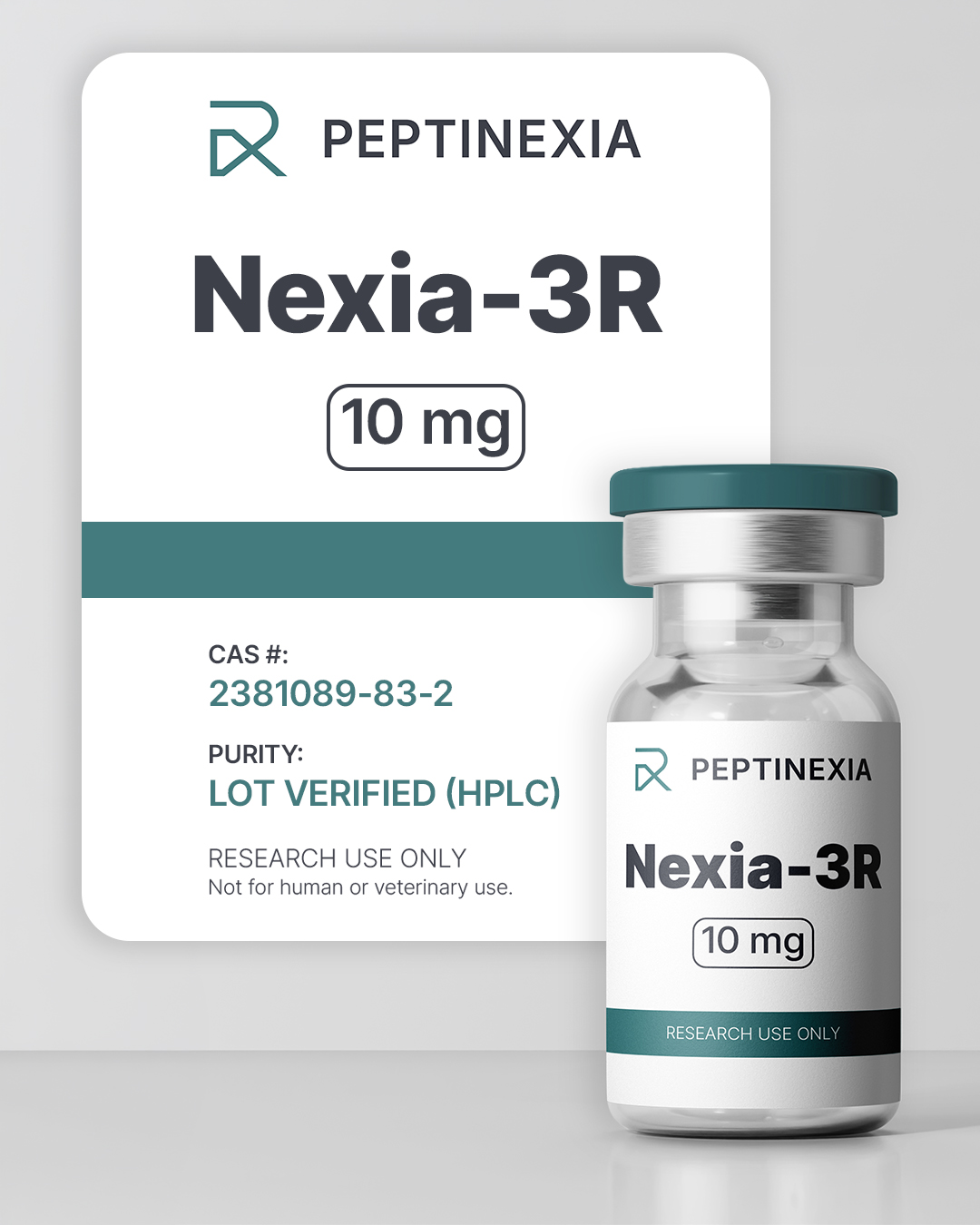
Nexia-3R

Nexia-3R is a synthetic triple-agonist peptide investigated for activity at the GLP-1, GIP, and glucagon receptors.

$45.00

$45.00
1 - 2 vials
$42.75 (5% off)
3 - 5 vials
$40.50 (10% off)
6+ vials

What is Nexia-3R?
Nexia-3R is a synthetic triple agonist peptide investigated for activity at the glucagon-like peptide-1 (GLP-1), glucose-dependent insulinotropic polypeptide (GIP), and glucagon receptors. Designed to engage multiple metabolic signaling pathways simultaneously, the compound has attracted significant research interest for its potential role in energy regulation, nutrient utilization, and metabolic signaling processes.

Research Interest
Nexia-3R is being studied for mechanisms related to metabolic regulation and whole-body energy balance. Areas of investigation include appetite signaling pathways, glucose metabolism, lipid utilization, energy expenditure, and hormonal coordination involved in metabolic homeostasis. Its multi-agonist design allows researchers to examine how simultaneous receptor activation influences complex metabolic systems compared with single-pathway peptide agonists.

Mechanisms Under Investigation
Current research examines how combined activation of GLP-1, GIP, and glucagon receptors affects central appetite signaling, insulin and glucagon dynamics, gastric emptying, and energy expenditure pathways. Studies suggest coordinated receptor signaling may influence nutrient partitioning and metabolic efficiency through both peripheral endocrine activity and central nervous system signaling mechanisms.

Current State of Research
Nexia-3R remains an investigational compound undergoing active clinical research. Published studies include controlled human trials evaluating metabolic parameters alongside ongoing investigations into long-term physiological effects and signaling mechanisms. Research continues to refine understanding of its pharmacology, safety profile, and broader metabolic interactions.
Lot IDPurityNet ContentEndotoxinSterility
NX3010031626199.7 %9.5 mg (95.4 %)19.8 EU/vial
Content
10 MG
Lot Size
100 vials
Purity
99.7 %
Net Content
9.5 mg (95.4 %)
Endotoxin
19.8 EU/vial
Sterility

Lyophilized (Dry Powder) — Unopened Vials
Unopened lyophilized vials should be stored away from direct light and heat. For use within a few weeks, room temperature storage is acceptable. For storage over several months, refrigeration at 2–8°C (36–46°F) is recommended. For long-term storage, freezing best preserves peptide integrity.

When removing a vial from frozen storage, allow it to reach room temperature before opening to prevent condensation from introducing moisture into the vial.

Reconstitution
Reconstitute using bacteriostatic water (BAC). Inject the solution slowly down the inside wall of the vial rather than directly onto the peptide cake. Gently swirl until fully dissolved; do not shake. Vigorous shaking may cause foaming and mechanical stress to the peptide structure.

Reconstituted Vials
After reconstitution, store vials refrigerated at 2–8°C (36–46°F) and protected from light. Always use clean, sterile technique when accessing the vial to minimize contamination.

With proper refrigerated storage and aseptic handling, reconstituted peptide solutions commonly remain stable well beyond the frequently cited 28-day guideline, which pertains to the antimicrobial effectiveness of bacteriostatic water rather than the intrinsic peptide stability. Many researchers maintaining consistent sterile technique report usable stability in the 60–90 day range under controlled conditions.

General Guidelines

  • Keep vials away from excessive heat and prolonged light exposure.
  • Do not freeze after reconstitution.
  • Discard any solution showing cloudiness, discoloration, or visible particulate matter.
  • Label vials with the reconstitution date for tracking purposes.

Study 1: Triple–Hormone–Receptor Agonist Retatrutide for Obesity — Phase 2 Clinical Trial

Authors: Jastreboff AM et al.
Source: New England Journal of Medicine (2023)

Scientific Findings
This randomized, double-blind, placebo-controlled Phase 2 clinical trial evaluated the effects of retatrutide, a GLP-1/GIP/glucagon receptor triple agonist, in adults with obesity. Participants received once-weekly dosing over a 48-week period. The study reported dose-dependent changes in body weight alongside improvements in multiple metabolic parameters, including glycemic control and lipid measures.

Investigators noted that simultaneous activation of incretin and glucagon pathways produced metabolic effects distinct from single-receptor agonists, supporting the hypothesis that multi-receptor signaling may influence energy balance through complementary physiological mechanisms.

Plain English Interpretation
In this controlled human study, researchers evaluated how a triple-acting peptide influenced metabolism over time. Participants receiving the compound showed measurable changes in weight and metabolic markers compared with placebo. The results suggest that activating several metabolic hormone pathways at once may affect how the body regulates energy use and nutrient handling.


Study 2: Multi-Receptor Agonism and Metabolic Regulation — Mechanistic Basis of GLP-1, GIP, and Glucagon Co-Activation

Authors: Finan B et al.
Source: Nature Medicine

Scientific Findings
This research explored the biological rationale behind combined incretin and glucagon receptor activation. Experimental models demonstrated that co-agonism across GLP-1, GIP, and glucagon receptors influences appetite signaling, insulin secretion, lipid metabolism, and energy expenditure through complementary endocrine pathways.

The study proposed that balanced receptor activation may enhance metabolic efficiency by integrating central nervous system signaling with peripheral metabolic regulation, providing a framework for understanding next-generation multi-agonist peptides.

Plain English Interpretation
Scientists examined why activating multiple metabolic hormone receptors at the same time might work differently than targeting just one. Their findings suggest that each receptor contributes a separate role in controlling appetite, blood sugar, and energy use, and combining them may produce coordinated metabolic effects.


Study 3: Glucagon Receptor Agonism and Energy Expenditure in Metabolic Regulation

Authors: Habegger KM et al.
Source: Diabetes Journal

Scientific Findings
This study investigated the metabolic effects of glucagon receptor activation in experimental models. Researchers observed increases in energy expenditure and alterations in lipid metabolism associated with glucagon signaling pathways. These findings contributed to the conceptual development of multi-agonist therapies combining incretin and glucagon receptor activity.

The work highlighted glucagon signaling as a complementary mechanism to incretin pathways, helping explain the metabolic rationale underlying triple-agonist peptide design.

Plain English Interpretation
Researchers studied how activating the glucagon receptor affects metabolism and found it can increase energy use and influence how the body processes fats. This helped scientists understand why adding glucagon activity to incretin-based compounds could change overall metabolic regulation.


Study 4: Incretin Hormone Signaling and Central Appetite Regulation

Authors: Müller TD et al.
Source: Cell Metabolism

Scientific Findings
This review examined how incretin hormones such as GLP-1 and GIP influence appetite regulation through central nervous system pathways. Research summarized interactions between gut-derived hormonal signals and brain regions responsible for energy intake and metabolic control.

The findings provide context for multi-agonist peptides by illustrating how coordinated hormonal signaling may influence both peripheral metabolism and central appetite regulation.

Plain English Interpretation
Scientists reviewed how hormones released after eating communicate with the brain to regulate hunger and energy balance. Understanding these signaling pathways helps explain why compounds that activate multiple hormone receptors are being studied for broader metabolic effects.

Batch Details
ID
Content
Received Date
Lot Size
vials
Crimp Color
Cap Color
Testing Lab
Lab ID
Test Date
Peptide Purity
Net Peptide Content
Peptide-to-Excipients Ratio
Endotoxin
Sterility